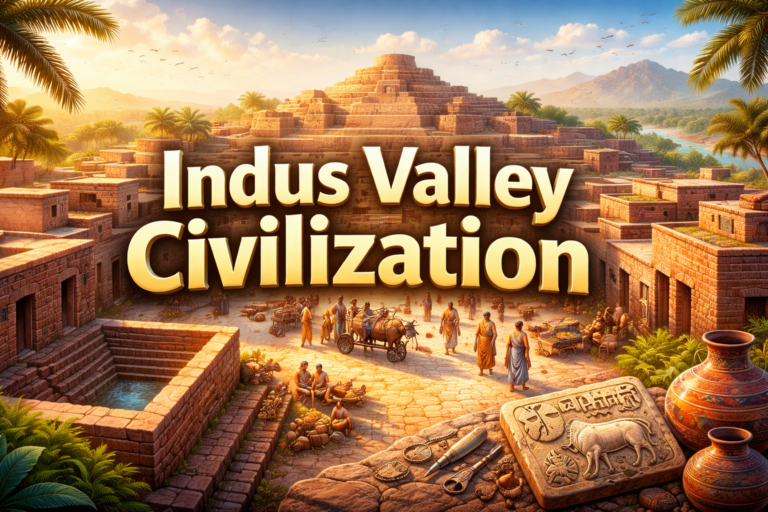
The Indus Valley Civilization is one of the oldest and most fascinating civilizations in the world. It developed thousands of years ago, at a time when humans were learning how to live together in organized communities. What makes the Indus Valley special is its advanced town planning, well-managed cities, and peaceful lifestyle. Unlike many ancient civilizations that are known mainly for wars and rulers, the Indus Valley is remembered for its smart urban systems, cleanliness, and strong social organization. Even today, historians and archaeologists are still discovering new facts about this civilization, which helps us understand how early humans built complex societies.
Introduction to the Indus Valley Civilization
The Indus Valley Civilization, also known as the Harappan Civilization, flourished around the Indus River and its tributaries. It was one of the world’s first urban civilizations and existed at the same time as ancient Egypt and Mesopotamia. This civilization shows how early humans adapted to their environment and created sustainable cities. The table below highlights the most important points for quick understanding.
| Key Aspect | Details |
| Civilization Name | Indus Valley / Harappan Civilization |
| Time Period | c. 2600–1900 BCE |
| Major Sites | Harappa, Mohenjo-daro |
| River System | Indus River |
| Economy | Agriculture, trade, handicrafts |
| Special Feature | Advanced drainage and town planning |
Geographical Location and Spread of the Indus Valley
The Indus Valley Civilization was spread across a vast area of northwestern South Asia. It covered parts of present-day India, Pakistan, and Afghanistan. The civilization developed mainly along river systems, which provided fertile soil for farming and easy routes for transportation. Rivers played a crucial role in daily life, supporting agriculture and trade. The wide geographical spread shows that the Indus people were well-connected and shared a common culture across distant regions. Despite this large area, the cities followed similar planning patterns, which suggests strong central ideas or shared traditions among the people.
Town Planning and Urban Life
One of the most impressive features of the Indus Valley Civilization is its well-planned cities. Streets were laid out in a grid pattern, cutting each other at right angles. Houses were built with baked bricks and often had bathrooms connected to covered drains. This shows that cleanliness and hygiene were important to the people. Cities were divided into residential areas and public spaces, such as granaries and assembly halls. The presence of efficient drainage systems tells us that the Indus people had advanced engineering knowledge, even by modern standards.
Economic Activities and Trade System
The economy of the Indus Valley Civilization was mainly based on agriculture, supported by trade and craftsmanship. People grew crops like wheat, barley, and cotton, making them among the earliest cotton producers in the world. Skilled artisans made pottery, beads, seals, and metal tools. Trade was carried out within the civilization and with distant regions, including Mesopotamia. Standardized weights and measures found at sites suggest fair trade practices. This strong economic system helped the civilization prosper for several centuries.
Social Life, Religion, and Culture
The social life of the Indus Valley people appears to have been peaceful and well-organized. There is little evidence of large palaces or royal tombs, suggesting a society with less social inequality. Religious practices are not fully understood, but seals and figurines hint at the worship of nature, animals, and fertility symbols. Daily life focused on family, work, and community living. Art, jewelry, and toys found during excavations show that people valued creativity and leisure along with survival.
Decline of the Indus Valley Civilization
The decline of the Indus Valley Civilization remains one of history’s greatest mysteries. There is no clear evidence of invasion or large-scale wars. Many historians believe that natural causes such as climate change, drying rivers, floods, or earthquakes may have played a major role. As water sources became unreliable, people may have slowly migrated to other regions. Over time, cities were abandoned, and the civilization faded away. Even though it declined, its legacy continues to influence later cultures of the Indian subcontinent.