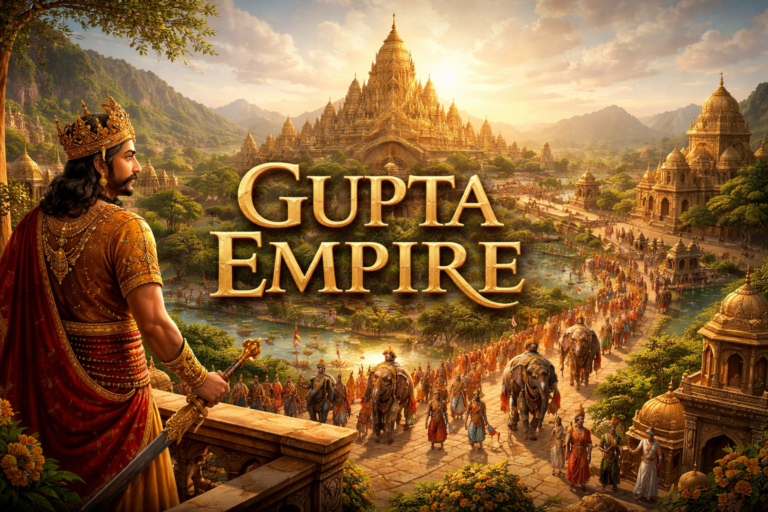
The Gupta Empire is often remembered as a golden phase in ancient Indian history. It was a time when art, science, literature, and administration reached remarkable heights. Unlike periods marked mainly by wars and destruction, the Gupta age stands out for cultural growth, stability, and intellectual progress. People lived in relatively peaceful conditions, trade flourished, and learning was highly respected. The rulers of the Gupta dynasty not only expanded their territory but also encouraged scholars, artists, and thinkers. Because of these achievements, historians describe the Gupta period as an age that shaped the foundations of classical Indian culture.
Introduction to the Gupta Empire
The Gupta Empire rose after the decline of the Mauryan Empire and established strong political control over a large part of northern India. It brought unity, efficient administration, and economic prosperity. The key features of the empire can be understood clearly through the table below.
| Important Aspect | Details |
| Dynasty Name | Gupta Dynasty |
| Time Period | c. 320 CE – 550 CE |
| Founder | Chandragupta I |
| Famous Rulers | Samudragupta, Chandragupta II |
| Capital | Pataliputra |
| Special Identity | Golden Age of India |
Rise and Expansion of the Gupta Empire
The Gupta Empire began its journey under Chandragupta I, who laid a strong foundation through smart alliances and territorial expansion. His son, Samudragupta, played a major role in transforming the kingdom into a powerful empire. Known as the “Napoleon of India,” Samudragupta expanded the empire through military campaigns as well as diplomatic strategies. Instead of destroying defeated kingdoms, he often allowed local rulers to continue under Gupta authority. This approach helped maintain stability and loyalty across regions. By the time of Chandragupta II, the empire reached its greatest extent, covering most of northern and central India.
Administration and Political System
The Gupta rulers followed a well-organized administrative system. The empire was divided into provinces, districts, and villages, each managed by officials. While the king held supreme authority, local administration played an important role in day-to-day governance. Village councils handled local issues, showing an early form of decentralization. Taxes were collected in a systematic way, mainly from agriculture, trade, and crafts. Law and order were maintained effectively, and punishments were generally less harsh compared to earlier periods. This balanced administration helped create trust between the rulers and the people.
Art, Architecture, and Literature
The Gupta period witnessed extraordinary progress in art and culture. Temple architecture developed with beautifully carved stone temples and sculptures. Cave paintings, especially those at Ajanta, reflect high artistic skills and deep emotional expression. Literature also flourished during this time. Sanskrit became the main language of scholars, and great works like plays, poems, and epics were written. Kalidasa, one of India’s greatest poets and dramatists, belonged to this era. His works continue to be read and admired even today, showing the lasting cultural impact of the Gupta age.
Science, Education, and Economic Life
The Gupta Empire made significant contributions to science and education. Scholars made advances in mathematics, astronomy, and medicine. The concept of zero and the decimal system were developed during this time, which later influenced the entire world. Universities such as Nalanda attracted students from distant lands. Economically, the empire was prosperous due to agriculture, internal trade, and foreign trade with Rome and Southeast Asia. Gold coins issued by Gupta rulers reflect strong economic conditions and skilled craftsmanship.
Decline of the Gupta Empire
Despite its achievements, the Gupta Empire eventually declined. Weak successors, internal conflicts, and reduced administrative control weakened the central authority. Repeated invasions by the Hunas further damaged the empire’s stability. Gradually, provinces became independent, and the empire broke into smaller kingdoms. By the mid-6th century, Gupta rule had come to an end. However, the cultural, scientific, and artistic legacy of the Gupta Empire continued to influence Indian society for centuries, making it one of the most respected periods in Indian history.