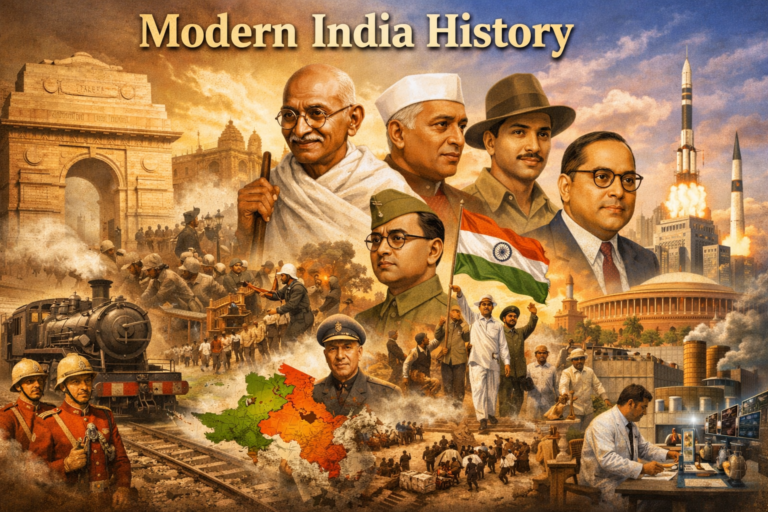
Modern India is the story of a nation that moved from colonial rule to becoming the world’s largest democracy. It is a journey filled with struggle, sacrifice, reform, and resilience. From the fight against British rule to the shaping of a democratic republic, Modern India reflects how ordinary people, visionary leaders, and social movements came together to change the course of history. This period not only transformed India politically but also reshaped its society, economy, and cultural identity. Understanding Modern India helps us understand how present-day India was formed and why its institutions, values, and challenges look the way they do today.
Introduction to Modern India
The period of Modern India generally begins with the establishment of British rule and ends with independence and nation-building. It covers political movements, social reforms, economic changes, and the rise of nationalism. The table below gives a clear snapshot of the most important aspects of Modern India.
| Aspect | Details |
| Time Period | 1757 to post-1947 |
| Major Power | British East India Company, British Crown |
| Key Theme | Nationalism and freedom struggle |
| Important Outcome | Independence in 1947 |
| Political System | Democracy |
| Key Leaders | National movement leaders |
British Rule in India and Its Impact
The foundation of Modern India was deeply influenced by British colonial rule. After the Battle of Plassey in 1757, the British slowly took control over Indian territories. British policies changed India’s economy, administration, and education system. While railways, modern education, and legal systems were introduced, these developments mainly served colonial interests. Traditional industries declined, heavy taxation affected farmers, and economic exploitation became common. At the same time, exposure to Western ideas like liberty, equality, and rights created political awareness among Indians. This contradiction—development on one side and exploitation on the other—became the driving force behind the rise of resistance and nationalism.
Rise of Indian Nationalism
Indian nationalism grew gradually as people from different regions began to see themselves as part of one nation. Educated Indians started questioning British policies and demanding a voice in governance. The formation of the Indian National Congress in 1885 marked a turning point. Early leaders believed in peaceful dialogue, petitions, and reforms. Over time, nationalism reached common people through newspapers, public meetings, and local movements. The idea of freedom was no longer limited to elites; it became a mass feeling shared by farmers, workers, students, and women. This growing unity laid the foundation for large-scale national movements.
Freedom Struggle and Mass Movements
The freedom struggle transformed Modern India into a people’s movement. Under the leadership of Mahatma Gandhi, the fight against British rule took a new direction. Non-violence and truth became powerful tools of resistance. Movements like Non-Cooperation, Civil Disobedience, and Quit India brought millions onto the streets. Ordinary Indians boycotted foreign goods, protested unjust laws, and faced imprisonment with courage. Alongside Gandhi, leaders like Jawaharlal Nehru, Subhas Chandra Bose, and Bhagat Singh inspired people with different approaches but a shared goal—freedom. These movements shook the foundations of British rule.
Social and Religious Reform Movements
Modern India was also shaped by powerful social and religious reform movements. Reformers worked to remove social evils such as caste discrimination, child marriage, and inequality against women. Movements led by Raja Ram Mohan Roy, Swami Vivekananda, and Jyotiba Phule encouraged education, rational thinking, and social justice. These reforms helped Indians question outdated practices and build a more inclusive society. Women began participating more actively in public life, education expanded, and the idea of equality slowly gained ground. Social reform strengthened the freedom struggle by creating a society ready for change.
Independence and Nation Building
India achieved independence in 1947, but freedom also came with challenges like Partition, refugee crises, and economic hardship. The task of nation-building began immediately. A democratic constitution was adopted, guaranteeing fundamental rights and equality before law. Institutions were created to strengthen democracy, unity, and development. Planning focused on education, science, industry, and self-reliance. Despite difficulties, India chose the path of democracy and secularism. Modern India, as we see it today, is the result of these early decisions taken during the post-independence period.