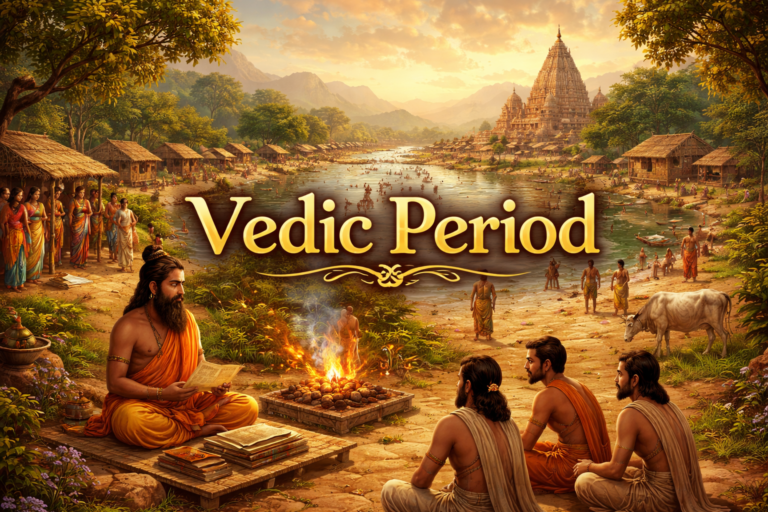
The Vedic Period marks a foundational phase in Indian history, shaping ideas, traditions, and social systems that continue to influence life even today. This period gets its name from the Vedas, ancient texts that reflect the beliefs, practices, and daily life of early Indo-Aryan people. Rather than being a time of kings and empires alone, the Vedic Period was deeply connected to family life, nature, rituals, and community values. People lived close to rivers and forests, depended on agriculture and cattle, and passed knowledge orally from one generation to another. Over time, society evolved from simple tribal groups to more structured social and political systems. Understanding the Vedic Period helps us understand the roots of Indian culture, religion, and philosophy in a very human and relatable way.
Introduction to the Vedic Period
The Vedic Period is broadly divided into two phases—Early Vedic and Later Vedic—based on changes in society, economy, and religious practices. The table below summarizes the most important points in a clear and simple way.
| Aspect | Details |
| Time Period | c. 1500 BCE – 600 BCE |
| Main Sources | Rigveda, Samaveda, Yajurveda, Atharvaveda |
| Phases | Early Vedic and Later Vedic |
| Economy | Pastoral → Agricultural |
| Society | Tribal → Varna-based |
| Language | Sanskrit |
Early Vedic Period: Life of Pastoral Communities
The Early Vedic Period reflects a simple and close-to-nature way of life. People lived in small tribes and depended mainly on cattle for their livelihood. Cows were considered a symbol of wealth, and many social activities revolved around pastoral life. Agriculture existed but was not the main occupation. Society was largely equal, with no rigid class divisions. Families were patriarchal, yet women enjoyed respect and participated in religious rituals and debates. Religious life focused on natural forces like fire, rain, wind, and sun, which were worshipped as gods. Life during this period was community-oriented, and decisions were often taken collectively through assemblies, showing an early form of participatory tradition.
Later Vedic Period: Rise of Agriculture and Social Structure
The Later Vedic Period brought significant changes in daily life. As people settled permanently, agriculture became the main occupation, leading to surplus production and population growth. With these changes came a more complex social structure. The Varna system began to take a definite shape, dividing society into Brahmins, Kshatriyas, Vaishyas, and Shudras. This division gradually became hereditary. Kingship became stronger, and political authority was more centralized. Large rituals and sacrifices gained importance, and the role of priests increased. While society became more organized, it also became less flexible compared to the Early Vedic Period.
Religious Beliefs and Vedic Rituals
Religion during the Vedic Period was deeply woven into everyday life. In the early phase, worship was simple and centered around pleasing nature gods through prayers and offerings. Fire sacrifices played a major role, symbolizing a connection between humans and gods. In the later phase, rituals became more elaborate and complex. The idea of karma, rebirth, and salvation slowly developed, especially towards the end of the Vedic age. Philosophical thinking also began to emerge, questioning the meaning of life and the universe. This shift laid the foundation for later spiritual traditions in India.
Political Organization and Governance
Political life in the Vedic Period evolved gradually. In the Early Vedic age, the king was more of a tribal leader than an absolute ruler. His power was limited, and important decisions were taken with the help of assemblies. In the Later Vedic Period, kings became more powerful and authority became hereditary. Large kingdoms replaced small tribes, and warfare for land became more common. Taxes were collected, and officials assisted the king in administration. This transformation shows how political systems grew along with economic and social changes.
Education, Language, and Cultural Life
Education in the Vedic Period was based on oral tradition. Knowledge was passed from teacher to student through memorization and recitation. Students lived with their teachers and learned discipline, values, and skills along with religious texts. Sanskrit developed as a refined language of learning and communication. Cultural life included music, chanting, storytelling, and debates. These traditions helped preserve knowledge for centuries, even without written records. The emphasis on learning and values made education a respected part of society.