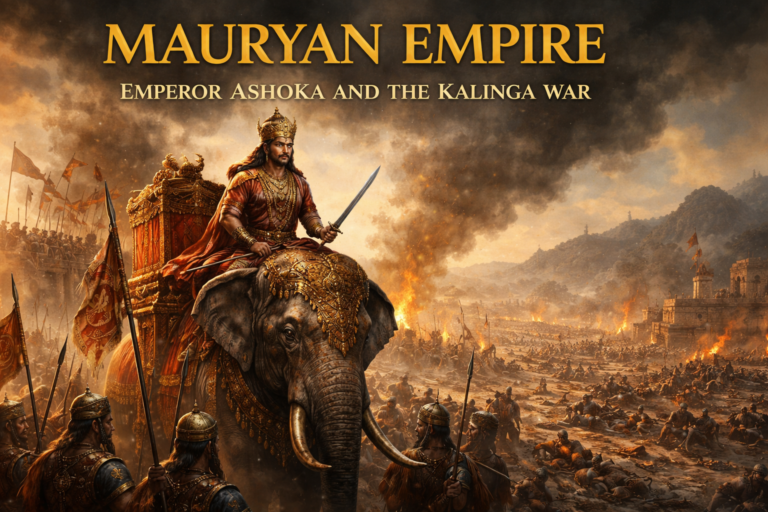
The Mauryan Empire marks a powerful and meaningful phase in ancient Indian history. It was an age when political unity, efficient administration, and moral thinking came together on a large scale. At the center of this era stands Emperor Ashoka, a ruler whose life took a dramatic turn after the Kalinga War. Unlike many kings remembered only for conquest, Ashoka is known for transformation—moving from violence to compassion. The story of the Mauryan Empire is not just about expansion of territory, but about how power, guilt, and humanity reshaped governance. This makes the Mauryan period deeply relevant even today, especially when discussing leadership, ethics, and responsibility.
Introduction to the Mauryan Empire
The Mauryan Empire was the first empire to unify most of the Indian subcontinent under a single administration. It laid the foundation for centralized governance and strong political institutions. The table below highlights the most important points for easy understanding.
| Aspect | Details |
| Empire Name | Mauryan Empire |
| Time Period | 322 BCE – 185 BCE |
| Founder | Chandragupta Maurya |
| Most Famous Ruler | Ashoka |
| Capital | Pataliputra |
| Turning Point | Kalinga War |
| Core Idea After War | Dhamma (moral governance) |
Rise and Expansion of the Mauryan Empire
The Mauryan Empire rose during a time of political confusion after the decline of smaller kingdoms in northern India. Chandragupta Maurya established the empire with the guidance of Chanakya, focusing on strong administration and military strength. Over time, the empire expanded across large parts of the Indian subcontinent. Roads, communication networks, and a disciplined army helped maintain control over distant regions. This expansion created stability and allowed trade, agriculture, and crafts to grow. By the time Ashoka ascended the throne, the Mauryan Empire had already become a powerful force, setting the stage for one of the most influential reigns in Indian history.
Emperor Ashoka: From Conqueror to Compassionate Ruler
In his early years, Ashoka ruled like a traditional imperial monarch, believing that strength and fear were necessary to maintain control. He was ambitious, determined, and focused on expanding the empire. However, Ashoka was also observant and deeply affected by human suffering. His reign is unique because it shows a ruler who was willing to change. After witnessing the consequences of war, Ashoka redefined kingship itself. He began to see his subjects not as people to be ruled by force, but as lives that mattered. This shift in mindset made Ashoka stand apart from most ancient rulers.
The Kalinga War and Ashoka’s Transformation
The Kalinga War was the most decisive event of Ashoka’s life. Though the Mauryan army won, the battlefield was filled with death, destruction, and grief. Thousands were killed, injured, or displaced. According to Ashoka’s own inscriptions, the sight of suffering deeply disturbed him. This was not a symbolic regret but a personal awakening. The war made Ashoka question the value of conquest achieved through violence. As a result, he gave up aggressive warfare and turned towards peace. The Kalinga War transformed Ashoka from a conqueror into a ruler guided by conscience.
Ashoka’s Dhamma and Moral Governance
After the Kalinga War, Ashoka introduced the concept of Dhamma as a guiding principle of governance. Dhamma was not a religion but a moral code that emphasized kindness, tolerance, respect for elders, non-violence, and compassion for all living beings. Ashoka promoted these values through inscriptions carved on pillars and rocks across his empire. He encouraged religious harmony and supported Buddhism while respecting other beliefs. Officials were appointed to ensure the welfare of people, animals, and travelers. Governance under Ashoka focused on ethical responsibility rather than fear, making his rule truly remarkable.
Administration, Legacy, and Historical Importance
The Mauryan administrative system was highly organized, with provinces, officials, and regular inspections. Ashoka strengthened this system by adding a human touch to governance. He viewed himself as a guardian rather than a ruler. His legacy survived long after the Mauryan Empire declined. Ashoka’s ideals influenced Indian political thought, Buddhist traditions, and even modern concepts of non-violence. Today, he is remembered not for the empire he expanded, but for the values he spread. The Mauryan Empire, under Ashoka, proved that true strength lies not only in power, but in empathy and moral courage.