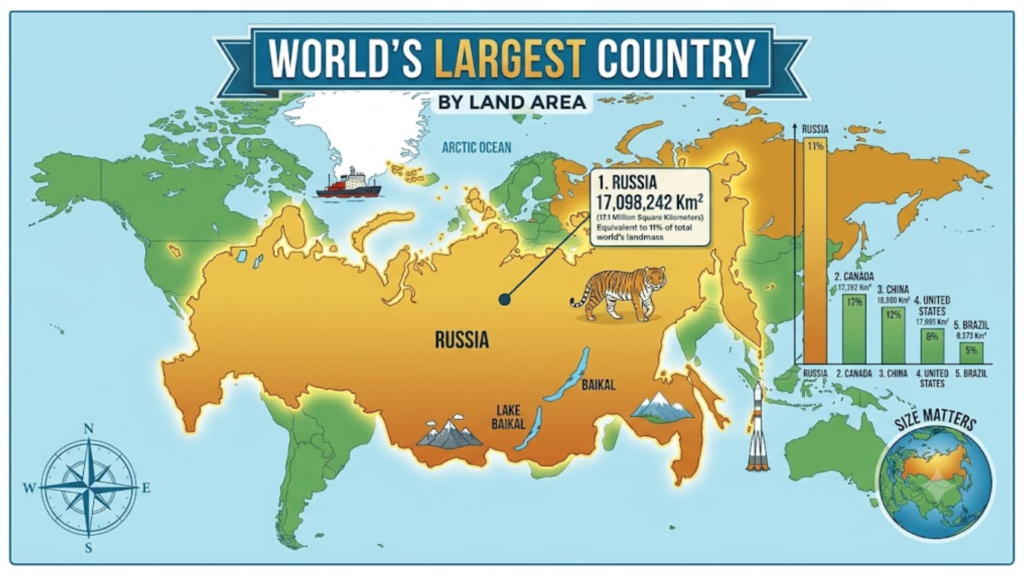

The world’s largest country is Russia, covering approximately 17.1 million square kilometers (6.6 million square miles). Stretching across Europe and Asia, Russia occupies about 11% of the Earth’s land surface, making it the largest country by area. It spans 11 time zones and shares borders with 14 countries, more than any other nation. Russia is famous for its vast forests, the Siberian wilderness, rich natural resources, and diverse landscapes. It is home to Lake Baikal, the world’s deepest freshwater lake, and has abundant reserves of oil, natural gas, and minerals. Although Russia is the largest country in the world, its population is much smaller than countries like India and China. Its enormous size makes it one of the most geographically and economically significant nations on Earth.
Why Is Russia the Largest Country in the World?
Russia is the largest country in the world because of its vast geographical area, stretching across both Europe and Asia. Covering about 17.1 million square kilometers, it occupies nearly 11% of Earth’s total land surface. Russia’s massive size is the result of centuries of territorial expansion, diverse landscapes, and historical development. From the icy Arctic coastline to dense forests, mountains, and open plains, the country spans an incredible range of climates and ecosystems. Its enormous territory also gives Russia abundant natural resources, strategic importance, and a unique position among the world’s largest nations.
- Covers approximately 17.1 million square kilometers of land.
- Spans two continents: Europe and Asia.
- Occupies nearly 11% of the Earth’s total land area.
- Stretches across 11 different time zones.
- Shares borders with 14 neighboring countries.
- Expanded over centuries through historical exploration and territorial growth.
- Contains vast forests, mountains, rivers, tundra, and grasslands.
- Rich in natural resources, including oil, natural gas, coal, and minerals.
- Home to Siberia, one of the world’s largest wilderness regions.
- Its enormous landmass makes Russia the largest country by area on Earth.
Top 10 Largest Countries in the World by Area
The largest countries in the world by area occupy vast territories across multiple climates, landscapes, and time zones. These nations play a major role in global geography, natural resources, biodiversity, and economic development. While Russia ranks first with more than 17 million square kilometers, countries such as Canada, China, the United States, and Brazil also cover enormous land areas. Large countries often possess abundant forests, rivers, mountains, deserts, and mineral wealth, making them strategically important on the world stage. The table below lists the top 10 largest countries in the world based on their total land area, according to internationally recognized geographic data.
| Rank | Country | Area (sq km) | Area (sq mi) | Continent |
| 1 | Russia | 17,098,246 | 6,601,670 | Europe & Asia |
| 2 | Canada | 9,984,670 | 3,855,103 | North America |
| 3 | China | 9,596,961 | 3,705,407 | Asia |
| 4 | United States | 9,525,067 | 3,677,649 | North America |
| 5 | Brazil | 8,515,767 | 3,287,956 | South America |
| 6 | Australia | 7,692,024 | 2,969,907 | Australia/Oceania |
| 7 | India | 3,287,263 | 1,269,219 | Asia |
| 8 | Argentina | 2,780,400 | 1,073,518 | South America |
| 9 | Kazakhstan | 2,724,900 | 1,052,100 | Asia & Europe |
| 10 | Algeria | 2,381,741 | 919,595 | Africa |
Russia’s Geography and Climate
Russia has one of the most diverse and extensive geographical landscapes in the world. As the largest country by area, Russia stretches across Eastern Europe and Northern Asia, covering vast plains, mountains, forests, rivers, and Arctic regions. Its enormous size creates a wide variety of climates, ranging from freezing Arctic conditions to milder continental weather. The country is home to famous natural features such as the Siberian forests, Ural Mountains, and Lake Baikal. Russia’s geography and climate have a major influence on its population, economy, natural resources, and way of life.
- Russia covers approximately 17.1 million square kilometers, making it the world’s largest country.
- It extends across 11 time zones from Europe to the Pacific Ocean.
- The country has diverse landscapes, including tundra, forests, mountains, plains, and deserts.
- The Ural Mountains separate European Russia from Asian Russia.
- Siberia contains some of the world’s largest forests and wilderness areas.
- Russia has major rivers, including the Volga River, Ob River, and Lena River.
- The climate varies from Arctic and subarctic in the north to continental and temperate regions in the south.
- Winters are extremely cold in Siberia, with temperatures often falling below -40°C.
- The country experiences long winters and short summers in many northern areas.
- Russia’s vast natural environment provides rich resources like oil, gas, coal, timber, and minerals.
Largest Countries by Area vs Population
The largest countries in the world by area are not always the countries with the highest populations. Some nations cover millions of square kilometers but have relatively small populations due to harsh climates, deserts, or remote locations. For example, Russia is the largest country by land area, while India and China have the world’s largest populations. Comparing country size and population helps understand global geography, resource distribution, and human settlement patterns. The table below highlights the world’s largest countries by area along with their estimated population, showing the difference between geographical size and population density.
| Rank by Area | Country | Total Area (sq km) | Estimated Population | Population Rank |
| 1 | Russia | 17,098,246 | 144 million | 9th |
| 2 | Canada | 9,984,670 | 41 million | 37th |
| 3 | China | 9,596,961 | 1.4 billion | 2nd |
| 4 | United States | 9,525,067 | 347 million | 3rd |
| 5 | Brazil | 8,515,767 | 212 million | 7th |
| 6 | Australia | 7,692,024 | 27 million | 55th |
| 7 | India | 3,287,263 | 1.46 billion | 1st |
| 8 | Argentina | 2,780,400 | 46 million | 32nd |
| 9 | Kazakhstan | 2,724,900 | 20 million | 65th |
| 10 | Algeria | 2,381,741 | 47 million | 31st |
Interesting Facts About the World’s Largest Country
Russia, the world’s largest country by area, is known for its enormous size, unique geography, rich history, and cultural diversity. Spanning across Europe and Asia, Russia covers more land than any other nation and contains some of the planet’s most remarkable natural wonders. From the frozen Arctic regions to the vast Siberian forests, the country offers a wide range of landscapes and climates. Its massive territory, abundant natural resources, and historical importance make Russia one of the most fascinating countries in the world. Here are some interesting facts that highlight the uniqueness of the largest country on Earth.
- Russia is the largest country in the world, covering around 17.1 million square kilometers.
- The country stretches across 11 time zones, the highest number of any nation.
- Russia is located in both Europe and Asia, making it a transcontinental country.
- It shares borders with 14 countries, including China, Kazakhstan, and Finland.
- Russia is home to Lake Baikal, the world’s deepest and one of the oldest freshwater lakes.
- The Siberian region contains some of the largest untouched wilderness areas on Earth.
- Russia has the world’s largest forest area, with vast boreal forests (taiga).
- The country has more than 100,000 rivers, including major rivers like the Volga and Lena.
- Russia possesses some of the world’s largest reserves of natural gas, oil, and minerals.
- The famous Trans-Siberian Railway is the longest railway line in the world.
- Russia experiences some of the coldest inhabited places on Earth, including Oymyakon in Siberia.
- Despite being the largest country by area, Russia ranks much lower in population compared to countries like India and China.
Russia stands as the largest country in the world by area, with its vast territory, diverse landscapes, and rich natural resources making it a unique nation on the global map. From the frozen Arctic regions and Siberian forests to its historic cities and valuable mineral reserves, Russia represents incredible geographical diversity. Although its population is smaller compared to countries like India and China, its enormous landmass gives it significant economic and strategic importance. Understanding Russia’s geography, climate, and interesting facts helps us appreciate why it remains one of the most influential and fascinating countries in the world.


