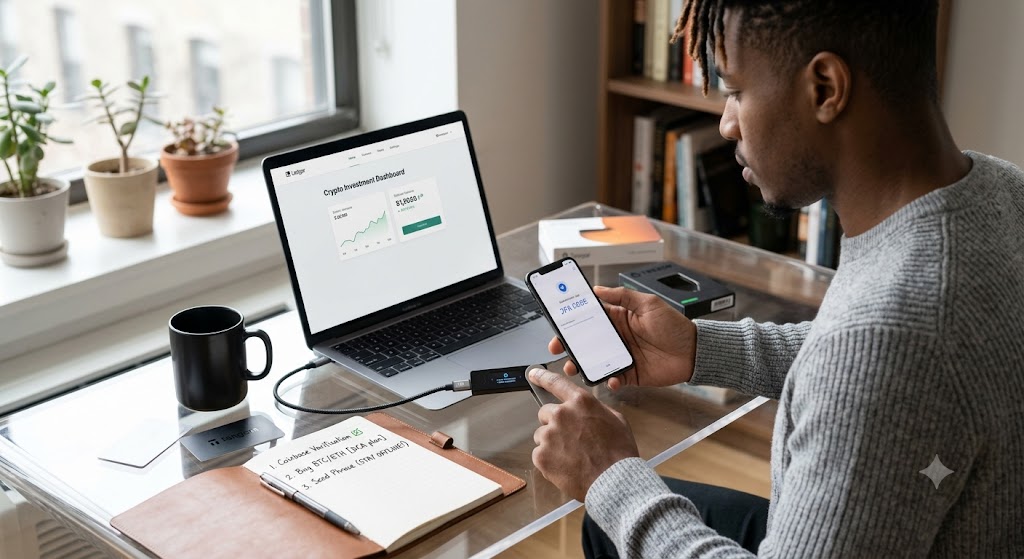

Investing in cryptocurrency offers high growth potential, but navigating digital asset markets requires a clear strategy, strict security practices, and disciplined risk management.
Whether you are buying your first fraction of Bitcoin or exploring Ethereum, following a structured process helps you invest safely and avoid costly rookie mistakes.
Step 1: Choose a Reliable Exchange & Create an Account
Your investment journey begins by selecting a compliant, high-liquidity crypto exchange.
- Select a Top Exchange: Sign up on trusted global platforms like Coinbase, Binance, or Kraken.
- Complete Identity Verification (KYC): Government regulations require uploading a valid ID (passport or driver’s license) and a selfie to unlock deposit features.
- Enable 2-Factor Authentication (2FA): Secure your account using app-based authenticators (like Google Authenticator) rather than SMS text codes to prevent SIM-swap attacks.
Step 2: Deposit Funds & Execute Your First Buy
Once verified, link a funding source to deposit traditional fiat currency (USD, EUR, INR) into your account.
- Choose a Payment Method: Bank transfers (ACH/SEPA) typically carry zero or very low transaction fees compared to credit or debit cards.
- Select Large-Cap Assets: Beginners should start with established cryptocurrencies that carry deep liquidity and proven longevity, such as Bitcoin (BTC) or Ethereum (ETH).
- Place an Order: Use a Limit Order to set the exact price you want to pay, or a Market Order for instant execution at current market rates.
Step 3: Secure Your Assets (Cold Storage vs. Hot Wallet)
Leaving large amounts of cryptocurrency on an exchange exposes your funds to third-party risks or platform insolvency. To truly control your money, transfer your private keys to a hardware wallet (cold storage).
| Security Feature | Hot Wallet (App / Web) | Cold Wallet (Hardware) |
| Internet Connection | Always online | Completely offline |
| Primary Use Case | Small balances, daily trading | Long-term holdings, wealth preservation |
| Protection Level | Moderate (vulnerable to phishing) | Maximum (keys never touch the web) |
| Typical Cost | Free software | $50 – $250 hardware purchase |
Top Recommended Hardware Wallets for Cold Storage
Tangem Wallet is a seedless, card-shaped cold storage option that uses NFC to approve transactions via your phone. It is ideal for beginners seeking fast setup.
Ledger Nano Gen5 offers secure touchscreen interaction combined with CC EAL6+ rated security chips. It is built for mobile-friendly multi-chain tracking.
Trezor Safe 7 features open-source code and an auditable security element (TROPIC01). It is the premier choice for maximum verifiable security.
Step 4: Essential Risk Management Rules
- Dollar-Cost Averaging (DCA): Invest a fixed amount regularly (e.g., $50 every week) rather than trying to time market highs and lows.
- The 5% Rule: Limit crypto exposure to 5%–10% of your total net worth to manage extreme price volatility.
- Never Share Your Seed Phrase: Your 12-to-24 word recovery phrase is the master master key to your funds. Store it physically on paper or metal and never type it online.