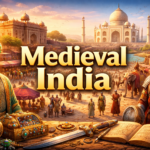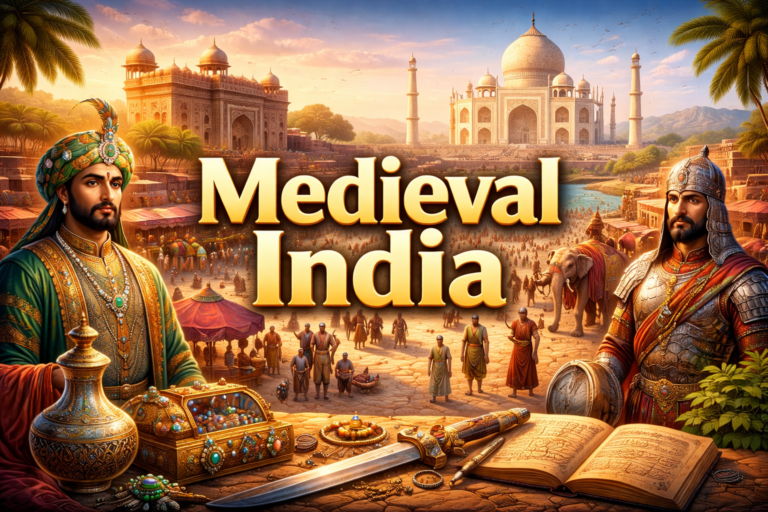
Medieval India marks a long and transformative phase of Indian history, roughly spanning from the 8th to the 18th century. This period witnessed the rise and fall of powerful dynasties, the growth of cities, the spread of new religions, and the blending of diverse cultures. Medieval India is especially known for its strong kingdoms, efficient administrative systems, magnificent architecture, and rich cultural traditions. It was a time when Indian society changed significantly—politically, socially, and economically. Trade expanded, art and literature flourished, and new ideas entered the subcontinent through foreign contacts. Understanding Medieval India helps us see how modern India’s cultural diversity, traditions, and institutions slowly took shape over centuries.
Introduction to Medieval India
Medieval India is generally divided into Early Medieval and Late Medieval periods. It saw the rule of several regional and imperial powers, each contributing uniquely to Indian history. The table below summarizes the most important points for quick and clear understanding.
| Key Aspect | Details |
| Time Period | c. 8th century – 18th century |
| Major Phases | Early Medieval & Late Medieval |
| Important Powers | Rajputs, Delhi Sultanate, Mughals |
| Economy | Agriculture, trade, crafts |
| Culture | Indo-Islamic art, literature, architecture |
| Administration | Centralized and provincial systems |
Rise of Major Kingdoms and Dynasties in Medieval India
One of the most important features of Medieval India was the emergence of powerful kingdoms and empires. In the early medieval period, regional rulers like the Rajputs, Palas, and Cholas dominated different parts of India. Later, large empires emerged that controlled vast territories. The Delhi Sultanate introduced new administrative ideas and strengthened central authority. This was followed by the Mughal Empire, which unified much of India under a strong and efficient system of governance. These dynasties not only expanded territories but also promoted art, culture, and economic growth.
Administration and Revenue System
Administration during Medieval India became more organized and systematic, especially under large empires. Rulers divided their kingdoms into provinces for better control and appointed officials to manage land, revenue, and law and order. Land revenue was the main source of income, as agriculture formed the backbone of the economy. Under the Mughals, detailed land measurement and revenue assessment methods were introduced to ensure fairness. Efficient administration helped maintain stability and allowed rulers to fund armies, public works, and cultural activities. This structured governance laid the foundation for future administrative systems in India.
Social Life and Religious Developments
Medieval Indian society was diverse and dynamic. People followed different religions, customs, and traditions. Hinduism and Islam were the two major religions, but Buddhism, Jainism, and Sikhism also played important roles. The Bhakti and Sufi movements promoted love, devotion, and tolerance, helping reduce religious tensions. Social life revolved around villages, towns, and growing cities. Though society had inequalities, cultural interaction between communities led to the development of a shared heritage that shaped Indian society for generations.
Art, Architecture, and Literature
Medieval India is famous for its artistic and architectural achievements. Grand forts, palaces, mosques, and temples were built using advanced engineering and artistic skills. Cities like Delhi and Agra became major cultural centers. Indo-Islamic architecture blended Persian and Indian styles, creating unique monuments. Literature also flourished in languages like Sanskrit, Persian, Arabic, and regional languages. Poetry, historical writings, and religious texts enriched India’s literary tradition.
Economy, Trade, and Decline of Medieval Powers
The economy of Medieval India was largely agrarian, supported by trade and handicrafts. Indian goods such as textiles, spices, and precious stones were in high demand in foreign markets. Trade routes connected India with Central Asia, the Middle East, and Europe. However, over time, internal conflicts, weak successors, and foreign invasions weakened medieval empires. By the 18th century, many powerful kingdoms declined, paving the way for European influence. Despite this decline, Medieval India left a lasting legacy in culture, administration, and social structure.