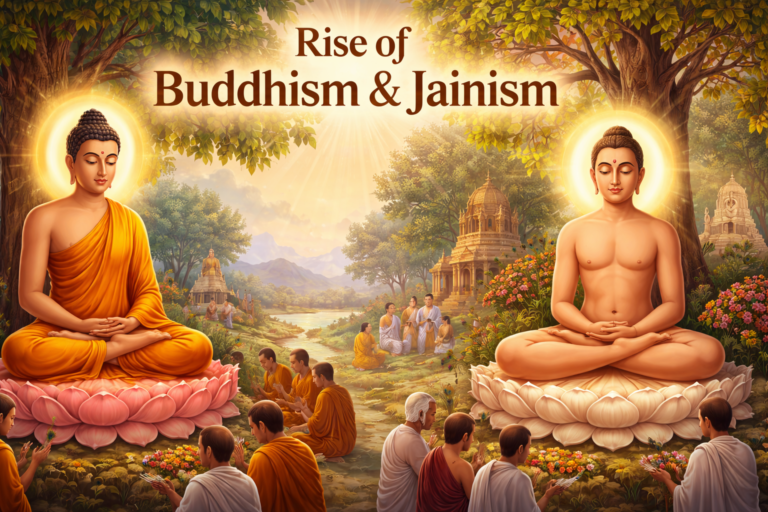
The rise of Buddhism and Jainism marks a turning point in ancient Indian history. Around the 6th century BCE, Indian society was going through deep changes. The rigid caste system, expensive rituals, animal sacrifices, and the dominance of priests had made religion distant from common people. Many were searching for a simpler, more meaningful path that focused on personal conduct rather than complex ceremonies. Buddhism and Jainism emerged as reform movements that questioned existing traditions and offered practical solutions to human suffering. Both emphasized non-violence, ethical living, and self-discipline. Their teachings were easy to understand and open to everyone, regardless of caste or gender. This human-centered approach helped both religions spread rapidly and influence Indian society, culture, and philosophy for centuries.
Introduction to the Rise of Buddhism & Jainism
The rise of Buddhism and Jainism was not sudden; it was the result of social, economic, and religious changes. Both religions developed in the same period and region and shared several ideas, yet they followed different paths toward spiritual liberation. The table below summarizes the most important introductory points.
| Aspect | Buddhism | Jainism |
| Founder | Gautama Buddha | Mahavira |
| Time Period | 6th century BCE | 6th century BCE |
| Main Idea | Middle Path | Extreme non-violence |
| Language Used | Pali | Prakrit |
| Goal | Nirvana | Moksha |
| Attitude to Rituals | Rejected | Rejected |
Social and Religious Conditions Behind Their Rise
The social structure of early Indian society played a major role in the rise of Buddhism and Jainism. The caste system had become rigid, limiting social mobility and creating inequality. Lower castes and women had little access to religious knowledge. At the same time, Vedic rituals were costly and complex, making them impossible for ordinary people to follow. Religious life had become more about rituals than moral behavior. Buddhism and Jainism strongly opposed this trend. They emphasized ethical conduct, compassion, and personal effort. Their rejection of caste-based discrimination and priestly dominance made them appealing to traders, artisans, and common people who were gaining importance in society.
Economic Factors and Urban Growth
Economic changes also contributed significantly to the rise of these two religions. The growth of agriculture, trade, and towns led to the emergence of a powerful merchant class. Traders preferred religions that supported honesty, peace, and non-violence, which helped business flourish. Both Buddhism and Jainism promoted non-violence and moral discipline, values that suited the needs of traders and urban communities. Monasteries were often located near trade routes, helping ideas spread quickly. Donations from wealthy merchants supported monks and institutions, allowing both religions to grow beyond local regions and become influential across northern India.
Core Teachings of Buddhism
Buddhism focused on understanding and overcoming human suffering. Its teachings were practical and deeply connected to everyday life. The Buddha emphasized the Middle Path, avoiding both extreme luxury and extreme self-denial. His message encouraged compassion, mindfulness, and wisdom. Buddhism rejected blind faith and encouraged followers to think, question, and experience truth for themselves. Meditation played a central role, helping individuals gain control over their desires and thoughts. The simplicity of Buddhist teachings and their focus on inner peace made them accessible and attractive to people from all backgro
Core Teachings of Jainism
unds.Jainism placed strong emphasis on self-control and strict ethical behavior. The central principle of Jainism is non-violence, not only toward humans but also toward animals, plants, and even microscopic life. Followers were expected to live disciplined lives, controlling desires and emotions. Jainism taught that the soul is trapped due to karma, and liberation can be achieved only through strict self-purification. Although the path was demanding, it appealed to those who valued moral purity and personal responsibility. Jainism’s stress on honesty and non-violence earned great respect in society.
Impact and Spread of Buddhism & Jainism
The impact of Buddhism and Jainism went far beyond religion. They influenced art, architecture, literature, and moral values in India. Buddhist stupas, monasteries, and universities became centers of learning. Jain contributions can be seen in temples, philosophy, and ethical traditions. Buddhism later spread to Sri Lanka, Southeast Asia, Central Asia, and East Asia, shaping cultures far beyond India. Jainism remained largely confined to India but continued to play a major role in shaping values like non-violence and tolerance. Together, these religions transformed Indian thought and left a lasting legacy that continues even today.