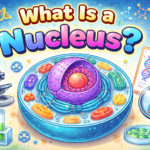
The nucleus is one of the most important and clearly defined organelles found in eukaryotic cells (plant and animal cells). It is often described as the control center of the cell because it regulates almost all cellular activities. The nucleus is usually spherical or oval in shape and is surrounded by a double-layered membrane called the nuclear envelope. Inside the nucleus, genetic material in the form of DNA is stored, which carries all hereditary information needed for growth, development, metabolism, and reproduction.
The nucleus ensures that genetic information is accurately copied and passed on during cell division. Without a nucleus, a cell cannot survive for long because it loses the ability to control protein synthesis and cell regulation. Some cells like mature red blood cells lack a nucleus, but they are highly specialized and have a limited lifespan. Overall, the nucleus plays a central role in maintaining the life and continuity of cells.
Structure of the Nucleus
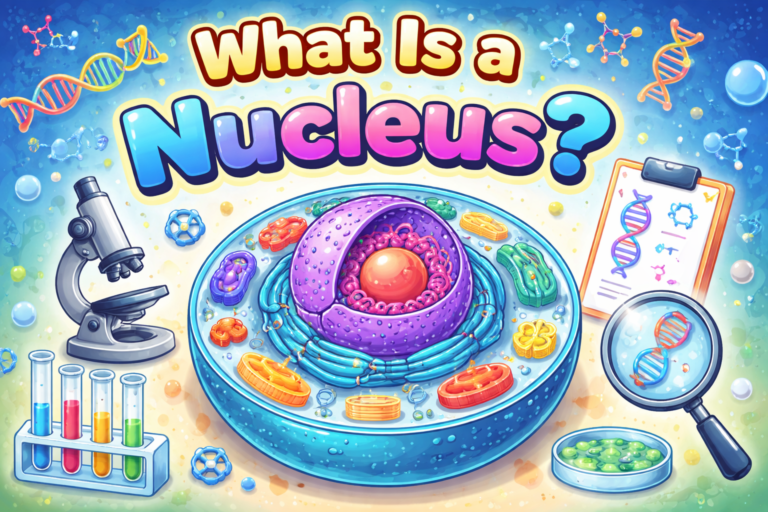
The structure of the nucleus is complex and well-organized, enabling it to perform its functions efficiently. It is enclosed by a nuclear envelope, which consists of two membranes separated by a space. The nuclear envelope contains nuclear pores that regulate the movement of molecules such as RNA and proteins between the nucleus and cytoplasm.
Inside the nucleus, there is a jelly-like fluid called nucleoplasm, which contains chromatin and the nucleolus. Chromatin is the uncoiled form of DNA combined with proteins; during cell division, it condenses to form chromosomes. The nucleolus is a dense, round structure responsible for producing ribosomal RNA (rRNA), essential for protein synthesis.
Each part of the nucleus works in coordination to ensure proper storage, expression, and regulation of genetic material. This organized structure helps the nucleus efficiently control cell activities.
Work (Functions) of the Nucleus
- Controls all activities of the cell
- Stores genetic material (DNA)
- Regulates protein synthesis
- Controls cell growth and metabolism
- Helps in cell division and reproduction
- Transfers hereditary characters to offspring
- Produces ribosomes through the nucleolus
Importance of the Nucleus in Cell Life
The nucleus is vital for the survival and proper functioning of a cell. It controls cell metabolism by regulating which proteins and enzymes are produced. Since enzymes control all biochemical reactions in the cell, the nucleus indirectly manages energy production, growth, and repair.
Another major importance of the nucleus is its role in heredity. It stores DNA, which contains genes passed from parents to offspring. During cell division, the nucleus ensures equal distribution of genetic material to daughter cells, maintaining genetic stability.
The nucleus also plays a key role in cell differentiation, allowing cells to specialize into different types such as muscle cells, nerve cells, or blood cells. Without the nucleus, coordination and regulation of these processes would not be possible, making it essential for life.
Nucleus and Cell Division
Cell division is a carefully regulated process in which the nucleus plays a central role. Before a cell divides, the DNA inside the nucleus replicates during the interphase stage so that each daughter cell receives a complete and identical set of genetic information. During mitosis, chromatin condenses into chromosomes, ensuring their accurate alignment and separation. The nuclear envelope temporarily breaks down to allow chromosomes to move freely and segregate properly. After division, a new nuclear envelope forms around each set of chromosomes, creating two nuclei. This precise process ensures genetic continuity, growth, tissue repair, and reproduction, while errors may cause mutations or diseases.