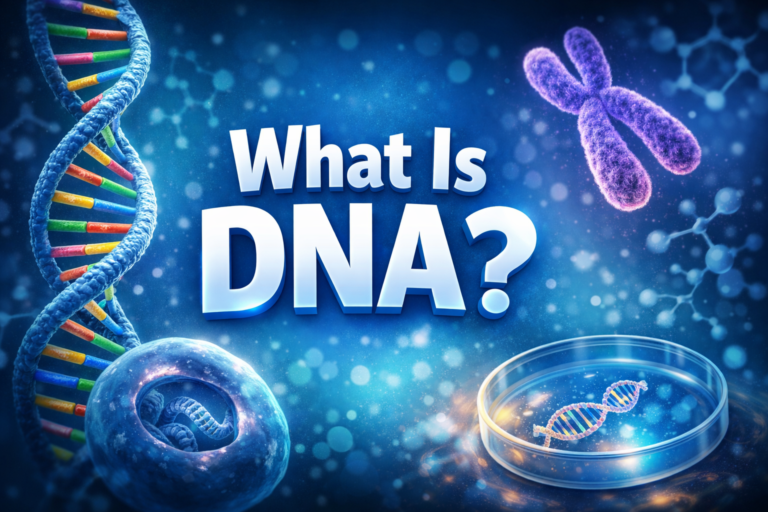
DNA stands for Deoxyribonucleic Acid, and it is the fundamental genetic material found in almost all living organisms. DNA carries the complete set of biological instructions that make each organism grow, develop, function, and reproduce. Every cell in your body contains DNA, and this DNA determines traits such as eye color, height, hair type, blood group, and even susceptibility to certain diseases. Structurally, DNA is a long, thread-like molecule tightly packed inside the nucleus of cells. It is made up of smaller units called nucleotides, which include a sugar molecule, a phosphate group, and a nitrogenous base. The specific sequence of these bases stores genetic information. DNA is unique to every individual (except identical twins), which is why it is widely used in medical diagnosis, forensic science, and ancestry testing. In simple terms, DNA acts as the instruction manual of life, guiding how cells behave and how organisms are formed.
Introduction to DNA
DNA is the molecular blueprint of life that controls how living organisms are built and maintained. From single-celled bacteria to complex human beings, DNA plays a central role in storing and transmitting genetic information from one generation to the next. DNA is mainly located in the nucleus of eukaryotic cells, while in prokaryotic cells it is found in the cytoplasm. The information stored in DNA is used to produce proteins, which are essential for structure, enzymes, hormones, and overall cellular functions. DNA has a double-helix structure, often compared to a twisted ladder, where the sides are made of sugar and phosphate, and the rungs are pairs of nitrogen bases. Understanding DNA is essential in fields like genetics, biotechnology, medicine, and evolution.
| Aspect | Description |
| Full Form | Deoxyribonucleic Acid |
| Location | Nucleus of cells (cytoplasm in prokaryotes) |
| Structure | Double helix |
| Main Function | Stores genetic information |
| Basic Units | Nucleotides |
| Base Pairs | Adenine–Thymine, Cytosine–Guanine |
Structure of DNA (Double Helix Explained)
The structure of DNA is one of its most remarkable features and is known as the double helix. It looks like a twisted ladder, where each side of the ladder is formed by alternating sugar (deoxyribose) and phosphate molecules. The steps or rungs of the ladder are made up of pairs of nitrogenous bases. There are four nitrogen bases in DNA: Adenine (A), Thymine (T), Cytosine (C), and Guanine (G). These bases always pair in a specific way: Adenine pairs with Thymine, and Cytosine pairs with Guanine. This base-pairing rule is essential because it allows DNA to replicate accurately during cell division. The two strands of DNA run in opposite directions and are held together by hydrogen bonds. This stable yet flexible structure enables DNA to store vast amounts of information in a compact form while still allowing it to be copied and read by cellular machinery.
Functions and Importance of DNA
DNA performs several vital functions that are essential for life. Its primary role is to store genetic information that determines the characteristics and functioning of an organism. DNA controls the synthesis of proteins by providing instructions through genes. These proteins regulate metabolism, repair tissues, fight infections, and carry out countless biological processes. DNA is also responsible for inheritance, as it passes genetic traits from parents to offspring during reproduction. Another important function of DNA is replication, which ensures that each new cell receives an exact copy of genetic material during cell division. Beyond biology, DNA has great importance in modern science and society. It is used in medical research to identify genetic disorders, in forensic science for criminal identification, and in evolutionary studies to understand relationships between species. Without DNA, life as we know it would not exist, making it one of the most crucial molecules in biology.