From the grand halls of London’s Victoria and Albert Museum to viral history podcasts, Akbar the Great is experiencing a massive cultural resurgence. More than 400 years after his death, the third Mughal Emperor remains a focal point for debates on governance, religious pluralism, and the very definition of a "Golden Age."
Here is why Jalal-ud-din Muhammad Akbar is dominating headlines and historical discussions in 2025.
The V&A Exhibition: Redefining the 'Golden Age'
The current landmark exhibition, "The Great Mughals: Art, Architecture and Opulence" (running through May 2025 at the V&A), has brought Akbar back into the global spotlight. This exhibition showcases over 200 objects, many never seen before by the public.
What makes this exhibit particularly timely is its focus on the internationalist culture Akbar fostered. It highlights how Hindustani artists, Iranian masters, and even European missionaries collaborated in imperial workshops to create a unique hybrid art form. This "globalization before its time" resonates deeply with today's interconnected world.
Beyond the Throne: Sulh-i-Kul and Modern Pluralism
In a world often divided by religious friction, Akbar’s policy of Sulh-i-Kul (Universal Peace) is being re-examined by scholars and political thinkers alike.
Recent discussions, notably in popular history podcasts like Empire, have highlighted Akbar's revolutionary approach to faith:
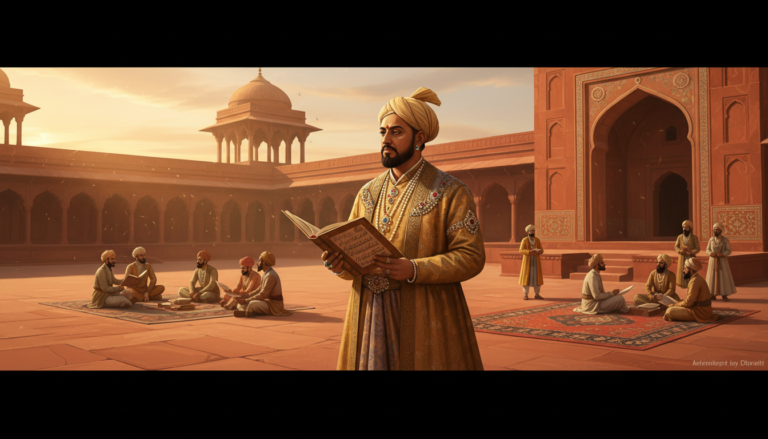
- The Ibadat Khana: His "House of Worship" where scholars of Islam, Hinduism, Christianity, Jainism, and Zoroastrianism debated the nature of truth.
- Abolition of Jizya: His 1564 decision to remove the tax on non-Muslim subjects was a radical step toward legal equality.
- Rational Inquiry: Akbar famously stated that no single religion held a monopoly on truth, a sentiment that feels remarkably modern in 2025.
The Mansabdari System: The World’s First Modern Civil Service?
Historians are increasingly looking at Akbar’s Mansabdari system not just as a military hierarchy, but as one of the earliest examples of a merit-based civil service.
Unlike European feudal systems of the time, Akbar’s system ensured that high-ranking nobles were moved frequently like modern-day diplomats to prevent them from becoming too powerful in any one region. This administrative genius allowed the Mughal Empire to manage a population of over 100 million people with surprising efficiency, providing a blueprint for governance that influenced later colonial and post-colonial structures.
Finding the Real Fatehpur Sikri
Archaeological interest in Fatehpur Sikri, Akbar’s short-lived capital, has spiked recently as digital restoration projects allow us to see the city as it appeared in its prime. New studies into the city's water management systems and the specific acoustic design of the Diwan-i-Khas (Hall of Private Audience) reveal an emperor who was as much an engineer and architect as he was a warrior.
Why Akbar Still Matters Today
Akbar’s legacy isn’t just about the past; it’s a mirror for the present. Whether it is through the lens of Indian school curriculum debates or his portrayal in modern streaming series, he represents the eternal struggle between central authority and cultural diversity.
As we look at the "historical charm" and "cultural richness" that topped Google's 2024 Year in Search, Akbar the Great stands as a symbol of an era when India was the wealthiest and most progressive power on the planet. To understand Akbar is to understand the roots of modern South Asia.
Notable Achievements at a Glance:
- Empire Expansion: Consolidated nearly the entire Indian subcontinent.
- Cultural Synthesis: Commissioned the Hamzanama, an epic artistic project featuring 1,400 large-scale paintings.
- Literacy & Knowledge: Despite being dyslexic or illiterate himself, he built one of the world's largest libraries and translated the Mahabharata and Ramayana into Persian.