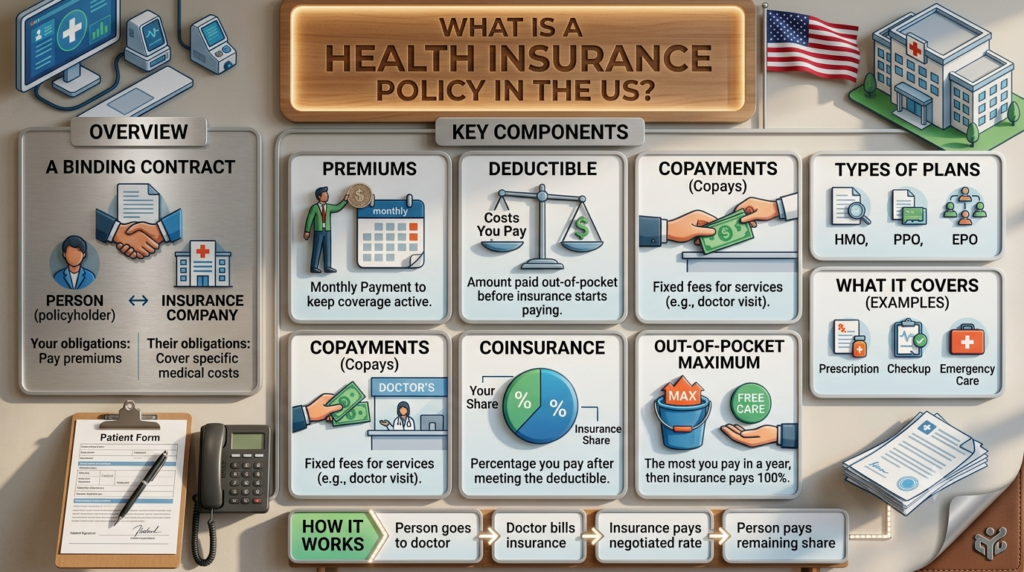

Health insurance is a type of financial protection that helps pay for medical care in the United States. A health insurance policy is a contract between you and an insurance company. You pay a monthly health insurance premium, and in return, the insurance company agrees to cover some of your eligible healthcare expenses according to the terms of your plan.
Healthcare costs in the US can be very high, especially for hospital stays, emergency room visits, surgeries, prescription drugs, and specialist care. Having the right health insurance coverage can help protect you from large and unexpected medical bills.
A health insurance plan may cover services such as doctor visits, preventive care, hospitalization, emergency care, laboratory tests, mental health services, maternity care, and prescription medications. However, the exact benefits depend on the plan you choose.
For Americans, choosing the best health insurance is an important financial decision because plans can differ significantly in premiums, deductibles, copays, coinsurance, provider networks, and out-of-pocket costs.
How Does Health Insurance Work in the US?
The US health insurance system generally works by sharing healthcare costs between the policyholder and the insurance company. You usually pay a monthly premium to keep your health insurance active. When you receive covered medical services, you may also have to pay a deductible, copayment, or coinsurance.
For example, suppose your health insurance plan has a $2,000 annual deductible. If you receive covered medical care before reaching that deductible, you may have to pay the allowed amount yourself, depending on the service. After you meet the deductible, your insurance may begin paying a percentage of covered costs.
Your health plan may also have an out-of-pocket maximum. This is an important feature because it limits how much you generally have to spend on covered, in-network healthcare services during a plan year.
The insurance company then pays its share according to the policy. This arrangement allows individuals and families to access healthcare without having to pay the full cost of every medical service themselves.
What Does a Health Insurance Policy Cover?
Health insurance coverage varies by plan, but many comprehensive plans cover a broad range of healthcare services.
Common covered services may include:
- Primary care doctor visits
- Specialist appointments
- Preventive healthcare
- Emergency room services
- Hospitalization
- Surgery
- Prescription drugs
- Laboratory tests
- Diagnostic imaging
- Mental health and substance use disorder services
- Maternity and newborn care
- Rehabilitation services
- Pediatric services
- Certain medical equipment
Under the Affordable Care Act, Marketplace health insurance plans must cover a set of essential health benefits. However, the amount you pay for these services can vary depending on your plan, provider network, deductible, copayment, and coinsurance.
It is important to review your health insurance benefits before receiving medical treatment because not every service, provider, medication, or treatment is covered in the same way.
What Is a Health Insurance Premium?
A health insurance premium is the amount you pay to an insurance company to maintain your health insurance coverage.
Premiums are typically paid every month, although some plans may provide different payment arrangements. You generally have to continue paying your premium even when you do not visit a doctor.
For example, if your monthly premium is $350, you would pay $4,200 in premiums over 12 months.
Premiums are only one part of the total cost of health insurance. A plan with a low monthly premium may have a higher deductible or higher out-of-pocket costs when you receive medical care.
Therefore, when comparing health insurance plans, you should consider the total potential cost rather than looking only at the monthly premium.
What Is a Health Insurance Deductible?
A health insurance deductible is the amount you generally pay for covered healthcare services before your insurance begins paying according to the plan’s deductible rules.
For example, imagine you have a $1,500 deductible. If you receive covered medical services that are subject to the deductible, you may need to pay the first $1,500 of the allowed costs before the insurance plan begins sharing those costs.
However, some services, particularly certain preventive services, may be covered before you meet your deductible, depending on the plan.
Deductibles can vary considerably between health insurance policies. Plans with lower monthly premiums may sometimes have higher deductibles, while plans with higher premiums may have lower deductibles.
What Is a Copayment?
A copayment, commonly called a copay, is a fixed amount you pay for a covered healthcare service.
For example, your insurance plan might require a $30 copay for a primary care visit. You pay the specified amount, while the insurance company covers the remaining eligible cost according to the plan’s rules.
Copays may apply to doctor visits, specialist visits, urgent care, prescription drugs, and other healthcare services.
The exact copayment amount depends on the health insurance plan.
What Is Coinsurance?
Coinsurance is the percentage of a covered healthcare cost that you pay after meeting your deductible, while your insurance company pays the remaining percentage.
For example, suppose your plan has 20% coinsurance after the deductible. If the allowed cost of a covered service is $1,000, you may pay $200 and the insurance company may pay $800, assuming the service is subject to that coinsurance and all plan requirements are met.
Coinsurance is different from a copay because a copay is usually a fixed dollar amount, while coinsurance is generally a percentage of the allowed cost.
What Is an Out-of-Pocket Maximum?
The out-of-pocket maximum is one of the most important features of a health insurance policy.
It is the maximum amount you generally pay during a plan year for covered healthcare services from in-network providers, subject to the plan’s rules. After reaching this limit, the health plan generally pays 100% of covered benefits for the remainder of the plan year.
The out-of-pocket maximum typically does not include your monthly health insurance premiums. It also may not include expenses for services that are not covered by your plan or care received outside the network when the plan does not cover it.
Because healthcare emergencies can become extremely expensive, understanding your plan’s out-of-pocket maximum is essential when comparing health insurance options.
What Is a Health Insurance Network?
A health insurance network is a group of doctors, hospitals, clinics, pharmacies, and other healthcare providers that have contracts with an insurance company or health plan.
Using an in-network provider can usually reduce your healthcare costs because the provider has agreed to negotiated rates with the health insurance company.
Some plans provide limited or no coverage for non-emergency care from out-of-network providers. Other plans may offer some out-of-network coverage but charge higher deductibles, copays, or coinsurance.
Before choosing a doctor or hospital, check whether the provider participates in your health plan’s network.
Types of Health Insurance Plans in the US
There are several common types of health insurance plans in the United States. Each plan structure has different rules regarding providers, referrals, costs, and out-of-network coverage.
HMO Health Insurance
A Health Maintenance Organization (HMO) generally requires members to use doctors and hospitals within the plan’s network, except in certain situations such as emergencies.
Many HMO plans require you to select a primary care provider and may require referrals before seeing certain specialists.
HMOs can be attractive to people who want predictable costs and coordinated care within a specific network.
PPO Health Insurance
A Preferred Provider Organization (PPO) generally gives you more flexibility when choosing healthcare providers.
You can typically see specialists without a referral, depending on the plan. PPO plans also generally provide some coverage for out-of-network care, although your costs may be higher.
Because of this flexibility, PPO health insurance plans may have higher premiums than some HMO plans.
EPO Health Insurance
An Exclusive Provider Organization (EPO) generally requires you to use providers within the plan’s network, except for emergencies.
EPO plans may not require specialist referrals, depending on the plan. They can be a middle-ground option for people who want some flexibility but are comfortable staying within a network.
POS Health Insurance
A Point-of-Service (POS) plan combines certain characteristics of HMO and PPO plans.
Members may have a primary care provider and may need referrals for specialists. Some out-of-network services may be covered, but they can cost more.
Employer-Sponsored Health Insurance
Many Americans receive health insurance through their employers. With an employer-sponsored health insurance plan, the employer may pay part of the monthly premium while the employee pays the remaining portion through payroll deductions.
Employer health insurance can provide employees with access to group rates and a selection of plan options.
The exact cost and benefits depend on the employer and the insurance plans offered. Employees should compare premiums, deductibles, provider networks, prescription drug coverage, and out-of-pocket maximums before selecting a plan during open enrollment.
Health Insurance Through the Marketplace
People who do not receive affordable health coverage through an employer may be able to purchase a plan through the Health Insurance Marketplace.
Marketplace plans are associated with the Affordable Care Act, commonly known as the ACA or Obamacare. Depending on household income and other eligibility factors, some people may qualify for financial assistance that reduces their monthly premiums or other healthcare costs.
Marketplace plans are available in different levels of coverage, including Bronze, Silver, Gold, and Platinum. These categories generally reflect how healthcare costs are divided between the plan and the policyholder, rather than the quality of medical care.
Medicare and Medicaid
The US also has government health insurance programs.
Medicare primarily provides health coverage for people age 65 and older, along with certain younger people who qualify because of specific disabilities or medical conditions.
Medicaid is a joint federal and state program that provides health coverage to eligible individuals and families with limited income. Eligibility rules and benefits can vary by state.
Both programs have different eligibility requirements, enrollment rules, coverage options, and costs.
How Much Does Health Insurance Cost in the US?
The cost of health insurance in the United States varies widely. Factors can include your age, location, household income, employer contribution, type of plan, coverage level, and whether you qualify for financial assistance.
When calculating the cost of health insurance, do not look only at the monthly premium. You should also consider:
- Annual deductible
- Copayments
- Coinsurance
- Out-of-pocket maximum
- Prescription drug costs
- Network restrictions
- Out-of-network expenses
- Employer contributions
- Available tax credits or subsidies
A plan with a low premium is not necessarily the cheapest option overall. If you regularly use healthcare services, a plan with a higher premium but lower deductible and lower out-of-pocket costs could potentially be more cost-effective.
How to Choose the Best Health Insurance Plan
Choosing the best health insurance plan depends on your healthcare needs and financial situation.
First, estimate how frequently you expect to visit doctors, specialists, hospitals, or pharmacies. Someone who rarely uses healthcare may prioritize a lower monthly premium, while someone who regularly receives medical care may focus more on deductibles and out-of-pocket costs.
Next, check the provider network. If you have a preferred doctor, hospital, or specialist, make sure they participate in the plan.
You should also compare prescription drug coverage, particularly if you take regular medications.
Finally, compare the total potential yearly cost of each plan. Consider premiums plus expected healthcare expenses and the maximum amount you could potentially pay for covered services.
Why Is Health Insurance Important?
Health insurance provides financial protection against potentially high medical expenses. Even a single emergency room visit, hospitalization, surgery, or major medical procedure can result in substantial healthcare costs without adequate coverage.
Insurance also makes it easier for people to access preventive care, primary care, specialist services, prescription medications, and other healthcare resources.
More importantly, health insurance can reduce the financial risk associated with unexpected medical problems. Instead of being responsible for the full cost of covered healthcare, you share those expenses with your insurance company according to the terms of your policy.
What Should You Check Before Buying Health Insurance?
Before purchasing a health insurance policy, carefully review the plan documents.
Pay particular attention to the:
- Monthly premium
- Annual deductible
- Copayments
- Coinsurance
- Out-of-pocket maximum
- Provider network
- Prescription drug coverage
- Covered medical services
- Out-of-network rules
- Enrollment and renewal requirements
Also check whether your preferred doctors, hospitals, and medications are covered.
Final Thoughts on Health Insurance in the US
A health insurance policy in the US is essentially a financial agreement that helps individuals and families pay for eligible medical care. In exchange for paying a premium, policyholders receive coverage according to the terms of their plan.
Understanding premiums, deductibles, copays, coinsurance, provider networks, and out-of-pocket maximums is essential before choosing a policy. The cheapest health insurance plan is not always the best option because the overall cost depends on how much healthcare you use and what the plan covers.
Whether you get coverage through an employer, the Health Insurance Marketplace, Medicare, Medicaid, or another source, carefully comparing health insurance coverage can help you make a more informed decision and avoid unexpected medical expenses.


